As technology advances, many patients are hearing about “robotic-assisted” joint replacements. While this innovation has transformed how we approach surgery, there is still a lot of confusion about what it actually entails.
Here are the five most common myths—and the facts you need to know.
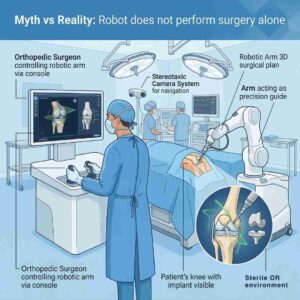
Myth 1: The robot is performing the surgery alone.
The Reality: The robot is a tool, not a surgeon. It cannot move or make decisions on its own. Your surgeon is in total control throughout the entire procedure. Think of it like a high-tech GPS for a car: the GPS gives the driver precise data and boundaries, but the driver is the one steering and making the turns.
Myth 2: Robotic surgery is only for “easy” cases.
The Reality: Actually, robotic assistance is incredibly valuable for complex cases. Because the system uses a 3D virtual map of your specific bone structure, it allows us to plan for unique anatomical variations that traditional manual instruments might not account for as easily.

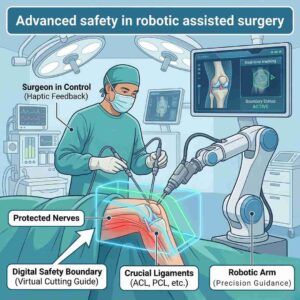
Myth 3: There is a higher risk of “malfunction.”
The Reality: Robotic systems have multiple fail-safes. If the surgeon moves even a millimeter outside the pre-planned “safe zone,” the robotic arm automatically provides haptic resistance or stops the tool. This added layer of safety actually reduces the risk of accidental damage to surrounding nerves and ligaments.
Myth 4: It’s just a marketing gimmick with no real benefit.
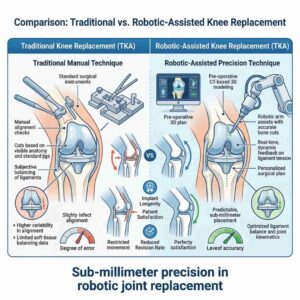
The Reality: Clinical data shows that robotic-assisted surgery allows for sub-millimeter precision. This level of accuracy ensures the implant is perfectly balanced. For a patient, this often translates to a joint that feels more “natural,” has a better range of motion, and may last longer due to reduced wear and tear.
Myth 5: Every patient should have robotic surgery.
The Reality: While it is a fantastic tool, it isn’t always the “only” or “best” way for every single person. Some patients may achieve excellent results with traditional minimally invasive techniques. During your consultation, we evaluate your specific X-rays and lifestyle to determine which surgical approach offers you the highest chance of success.