Total Knee Arthroplasty (TKA)
Indications:
Total Knee Arthroplasty (TKA), commonly known as Total Knee Replacement, is recommended for patients suffering from severe knee joint damage that significantly limits daily activities and causes persistent pain. The most common indication is end-stage osteoarthritis, where the protective cartilage within the knee joint wears away over time, leading to bone-on-bone friction. Other conditions that may require this procedure include rheumatoid arthritis, which causes chronic inflammation of the joint lining, and post-traumatic arthritis that develops after fractures or ligament injuries around the knee. TKA is generally considered when conservative treatments such as medications, physiotherapy, lifestyle modification, and joint injections no longer provide adequate relief.
Technique:
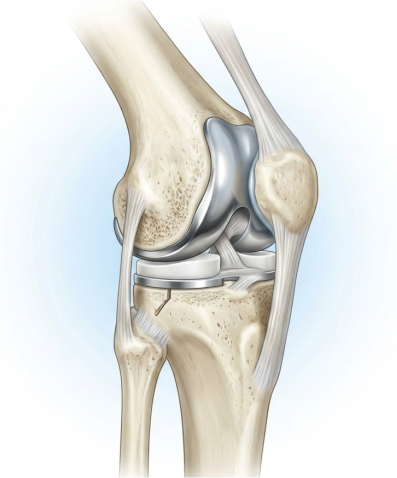
The surgery is performed under sterile operating room conditions using advanced orthopedic instruments and precise surgical techniques. A midline incision is made over the front of the knee to access the joint. The patella (kneecap) is gently moved aside to allow clear visualization of the damaged joint surfaces. Using specialized precision cutting guides, the surgeon carefully removes the worn or damaged cartilage and a small portion of bone from the distal femur and proximal tibia in a process known as bone resectioning.
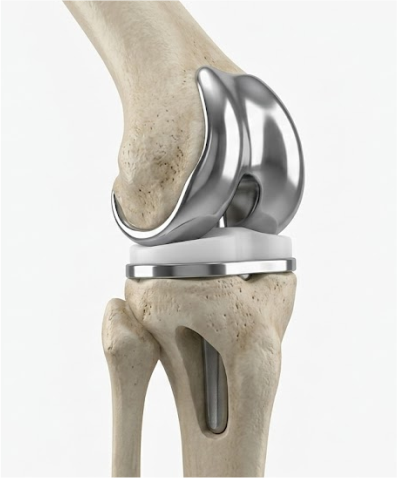
Once the joint surfaces are prepared, the artificial components are positioned. The femoral component, usually made from cobalt-chromium alloy, replaces the damaged surface of the thigh bone, while the tibial component, typically made of titanium or a similar durable metal, is placed on the shinbone. These components are usually secured with polymethylmethacrylate (bone cement) to ensure stable fixation. A highly cross-linked polyethylene insert is then placed between the metal components to act as a smooth, low-friction bearing surface that allows natural joint movement.
Objective:
The primary goal of Total Knee Arthroplasty is to relieve chronic knee pain, restore joint stability, and improve mobility. The procedure also corrects varus or valgus deformities (bow-legged or knock-knee alignment) and helps restore a functional range of motion, typically from 0° full extension to around 120° or more of flexion depending on the patient. By replacing the damaged joint surfaces with durable prosthetic components, TKA enables patients to return to everyday activities such as walking, climbing stairs, and performing routine tasks with significantly less discomfort and improved quality of life.
Knee Replacement Surgery in Hisar
Advanced Care for Pain-Free Movement
Knee replacement surgery helps patients suffering from severe knee pain due to arthritis or injury regain mobility and improve their quality of life. When medications, injections, and physiotherapy no longer provide relief, surgery becomes an effective solution to restore joint function and reduce pain.
🔹 What is Knee Replacement Surgery?
Knee replacement is a procedure in which the damaged parts of the knee joint are replaced with artificial components to restore smooth movement. It is recommended when the cartilage wears out and the bones start rubbing against each other, causing pain, stiffness, and limited mobility.
🔹 Types of Knee Replacement
Total Knee Replacement
All three compartments of the knee joint are replaced. This is usually recommended when arthritis affects the entire knee.
Partial Knee Replacement
Only the damaged portion of the knee is replaced while the healthy parts are preserved. This is suitable when arthritis is limited to one area.
The choice depends on the extent of damage, age, lifestyle, and your surgeon’s evaluation.
🔹 Recovery and Rehabilitation
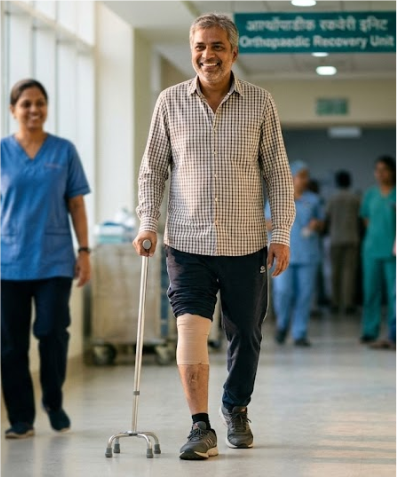
Most patients stay in the hospital for 3–5 days after surgery. Walking begins with support, and gradual improvement is seen over the next few weeks. With proper physiotherapy, many patients return to normal daily activities within 4–6 weeks.
🔹 Benefits of Knee Replacement
Significant pain relief
Improved mobility and flexibility
Better quality of life
Ability to perform daily activities comfortably
Q1. When should I consider knee replacement surgery?
You should consider surgery when knee pain persists despite medication, physiotherapy, or injections and starts affecting daily activities like walking or climbing stairs.
Q2. How long does knee replacement surgery take?
The procedure usually takes about 1 to 2 hours, depending on the complexity of the case.
Q3. Is knee replacement surgery safe?
Yes, it is a commonly performed and safe procedure when done by an experienced orthopedic surgeon, with a high success rate.
Q4. How long does recovery take?
Most patients resume routine activities within 4–6 weeks, while full recovery and strength improvement may take a few months.
Q5. Will I be able to walk normally after surgery?
Yes, the goal of surgery is to relieve pain and help you walk comfortably with improved joint movement.